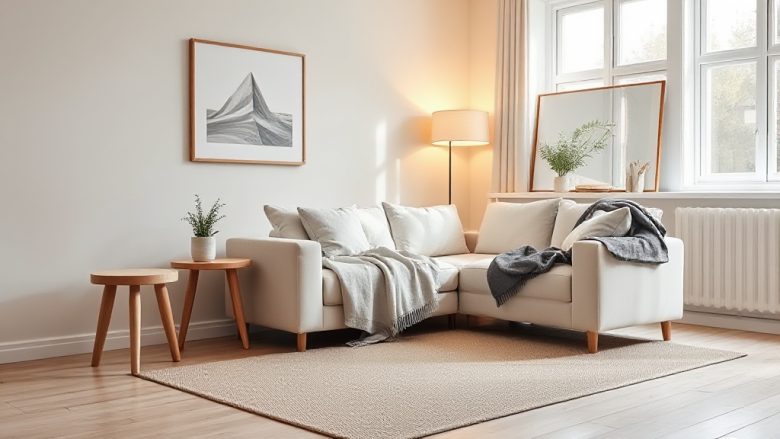
Yes, scandinavian interior design on a budget works, because the style depends on light, wood and restraint rather than price. You do not need a designer sofa or a statement lamp that costs a week’s rent. You need a plan, and the plan starts with a buying order: paint and light first, then wood, then textiles, then the few decorative pieces that finish the room. Get that order right and a rented flat can look like a considered Nordic home for a few hundred pounds.
The assumption that stops most people is that the look comes from the furniture. It does not. Walk through any well-done Scandinavian room and the expensive pieces are almost invisible. What you notice is how much light bounces around, how little clutter sits on the surfaces, and how the wood tones repeat from the floor to the shelf to the frame on the wall. Those are cheap things. They are just easy to get wrong.
The Three Elements That Actually Carry the Look
Scandinavian design is a small set of ideas repeated patiently. Three of them do almost all the work, and none of them require a designer budget.
Light. This is the foundation, not a finishing touch. The style grew out of long dark winters, so every room is built to pull in and bounce as much daylight as possible. If you are renting and cannot change the windows, you can still work with what you have: keep sills clear, use a pale or sheer curtain instead of a heavy one, and place a mirror opposite the main window so it throws light back into the room. A single well-placed mirror does more for the look than a new armchair.
Wood. One or two wood tones, repeated, warm the whole scheme. Light oak, ash and pale birch are the classic choices because they read as calm rather than heavy. The trick is repetition, not quantity. A cheap oak-effect side table, a wooden chopping board left out on the counter, and a simple wooden frame above the sofa all speak the same language. Mixing six different wood tones is what makes budget rooms look muddled.
Restraint. This is the element people skip, and it is the one that separates a real Scandinavian room from a showroom imitation. Fewer objects, more empty space, and a limited palette of white, off-white, grey, black and one soft accent. Restraint costs nothing. It is the cheapest part of the whole style, and it is the part that most people fail at.
Notice what is missing from that list: expensive furniture. It is missing because it is not required.
Where to Spend and Where to Save
Think of your budget as a queue. Spend at the front of the queue, save at the back, and never let the back of the queue eat the front.
The front of the queue is the things you touch and look at every day: a decent wool or cotton throw, one good rug, and paint if you are allowed to use it. A wool throw in grey or oatmeal is the single most useful purchase in this style. It adds texture, it softens a cheap sofa, and it makes a room feel finished in a way that no ornament can. A flatweave or short-pile rug in a neutral tone does the same job for the floor. These are worth a little more because they are the items you notice constantly.
The middle of the queue is wood furniture, and this is where second-hand shopping earns its keep. Solid oak and teak pieces from the middle of the last century turn up constantly in charity shops, online marketplaces and house clearances, often for less than a flat-pack equivalent. They are usually better made, and they age in a way that veneer does not. A used oak chest of drawers with a few scratches is more convincing in this style than a new glossy unit, because the style likes things that look lived with.
The back of the queue is where you save hard: cushions, ceramics, vases, prints and small accessories. These are the items that tempt you to overspend and then quietly ruin the scheme. Buy them last, buy them few, and buy them in the same palette. A single ceramic vase in off-white is worth more to the room than five colourful ones. If you are working to a tight budget, this is the category to leave half-empty for a few months while you wait for the right thing.
One short list to keep you honest:
- Spend: one wool throw, one neutral rug, paint if permitted.
- Save: wood furniture, bought second-hand where possible.
- Delay: cushions, ceramics, prints and anything purely decorative.
If you follow that order, you will spend most of your money on the three or four things that change the room, and almost none on the things that only fill it.
Light, Decluttering and the Mistakes That Make Cheap Look Cheap
Before you buy anything else, deal with light and clutter. They are free, and they matter more than furniture.
Start with the bulbs. Most homes are lit by one harsh ceiling light in the middle of the room, which flattens everything and makes even good furniture look cheap. Replace it with two or three smaller sources: a floor lamp in a corner, a table lamp on a side table, a small light near the sofa. Warm white bulbs, not cool white. This is one of the cheapest changes you can make and one of the most visible. If you are renting and the ceiling fitting is fixed, a plug-in floor lamp solves the problem without touching the wiring.
Then declutter properly. Scandinavian rooms look calm because there is very little in them. Clear the windowsill, clear the coffee table, clear the kitchen counters. Put away the things you use but do not want to see. What is left should be a small number of objects with space around them. Space is the most underrated material in this style, and it is free.
Now the mistakes. The first is too many wood tones. Two is plenty; four looks accidental. The second is a cold palette with no texture, which reads as clinical rather than calm. Add wool, linen, a woven basket, a sheepskin over a chair, and the room warms up immediately. The third is clutter dressed up as styling: stacks of books, trays of candles, bowls of dried flowers. In this style, one object per surface is usually enough. The fourth is buying a full matching set of furniture, which looks like a catalogue page rather than a home. Mix one second-hand wood piece with what you already own and the room gains character for almost nothing.
There is one more mistake worth naming, because it catches people who are trying hard: buying small versions of everything. A tiny rug, a narrow sofa, a little lamp. Small pieces make a room feel smaller and cheaper. One larger rug that sits under the front legs of the sofa will do more for the space than three small ones, and it does not have to be expensive.
None of this requires a designer budget. It requires patience with the buying order, a willingness to buy second-hand, and the discipline to leave surfaces empty. Do those three things and the room will read as Scandinavian even if every piece in it cost very little.
Frequently Asked Questions
Can I do Scandinavian interior design on a budget in a rented flat?
Yes, and renters often have an advantage because the style is light and portable. Focus on things you can take with you: lamps, a rug, a throw, a mirror, second-hand wood furniture. If you cannot paint, use pale curtains and mirrors to bounce light, and keep the walls as clear as possible so the room feels brighter.
What is the cheapest change that makes the biggest difference?
Lighting. Replacing one bright ceiling light with two or three warm lamps around the room changes how everything else looks, including furniture you already own. It usually costs less than a single new chair and it is the first thing visitors notice.
Which wood tones should I choose on a small budget?
Stick to light ones: oak, ash or pale birch. They keep a small room feeling open and they are the easiest to find second-hand. Pick two tones at most and repeat them across furniture, frames and small accessories so the room feels deliberate rather than collected at random.
How do I stop a cheap Scandinavian room looking flat or cold?
Add texture, not colour. Wool, linen, sheepskin, rattan and unglazed ceramics all soften a pale palette without breaking the restraint that makes the style work. One textured throw and one woven basket will usually be enough to take the edge off a room that feels too clinical.