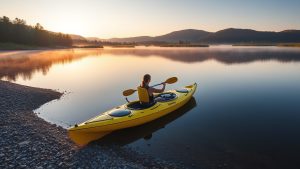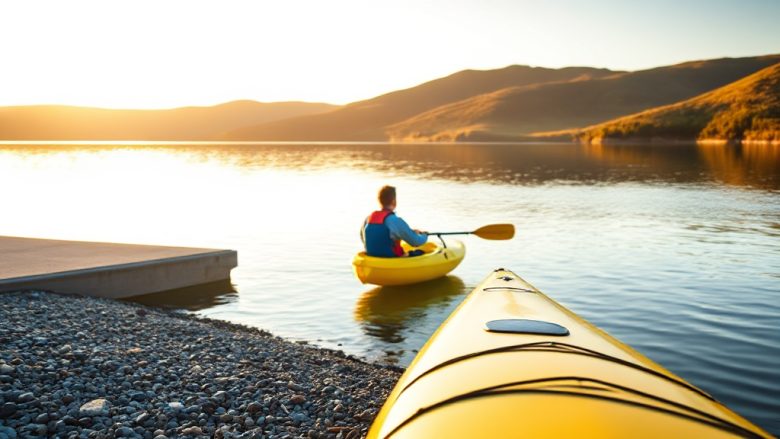
The best kayaking spot for a beginner isn’t the one with the prettiest view or the longest paddle. It’s the one where you can get in and out without drama. That’s the whole game. If you can launch from a flat, forgiving edge, sit down without tipping, and paddle twenty minutes without fighting a current, you’ll finish the day wanting to go again. If your first trip involves surf, tides and a scramble down a rocky bank, you’ll probably sell the kayak by Tuesday.
So this is a short, honest list. Five places that share the same beginner-safe feature: flat water, an easy launch, and no meaningful current. I’ve paddled all kinds, and I still remember my first wobbly launch — the boat sliding sideways, one foot in, one foot out, the whole thing threatening to tip before I’d even sat down. You don’t need that. What you need is a calm lake, a slow river or a sheltered bay with a proper slipway. Here are five types of spot that deliver exactly that, plus what to check before you go.
Why These Five Spots Suit a First Paddle
Before the list, one principle. Beginners need flat water and an easy entry point far more than they need scenery. A calm lake with a gravel beach beats a dramatic coastline every time for a first trip. Wind is the real enemy, not distance — a 10 mph breeze on open water will push you sideways faster than you can correct, and that’s what makes new paddlers panic. So every spot below is chosen because it’s sheltered, shallow at the edge, and simple to get back out of. If you’re searching for the best kayaking spots for beginners, start with these five and you’ll skip most of the trial and error I went through.
Each entry explains why it works for a first-timer and gives you a practical note on launch and parking. No links, no bookings, no fuss. Just water you can trust.
1. A Sheltered Reservoir With a Slipway
Reservoirs are often overlooked because they’re not glamorous, but they’re brilliant for beginners. The water is deep and still, the edges are usually managed, and there’s often a proper concrete slipway you can walk a kayak down without lifting it over rocks. Because reservoirs sit in valleys, the surrounding hills block a lot of wind, so even a breezy day can feel calm close to shore.
The launch is the reason to pick one. A slipway gives you a gentle gradient, so you can put the boat in the water, hold it steady, sit down and push off with your paddle — no scrambling, no wet feet. Parking is typically a dedicated car park a short walk from the water, which means you’re not carrying a heavy boat across a field. Go early in the morning when the water is glassy and the car park is empty.
2. A Slow, Wide River With Grassy Banks
A slow river is the closest thing to a moving walkway for a new paddler. If the current is gentle — think a wide, lowland river rather than anything with rapids — it does half the work for you. You can paddle upstream a little, turn around and drift back, and you’ll feel like you’ve covered ground without exhausting yourself.
Look for a stretch with grassy or gravel banks where you can slide the kayak in at a shallow angle, and ideally a public launch point or a riverside car park. Avoid anywhere with weirs, locks or fast narrowing channels; those create currents that catch beginners out. The practical note here is to paddle upstream first while you’re fresh, then float back to your start point. That way you’re never fighting the flow when your arms are tired, and you always know where you’re getting out.
3. A Small, No-Motor Lake in a Country Park
Country park lakes are built for exactly this. They’re small, they’re calm, and many ban motorboats and jet skis, which removes the wakes that tip beginners over. The water is usually shallow near the edge, so if you do fall in, you’re standing up in waist-deep water rather than swimming for your life.
The launch is typically a beach, a jetty or a gently sloping bank, and parking is right there — often with toilets and a café, which matters more than you’d think when you’re cold and hungry after an hour on the water. Because the lake is small, you can’t get lost or blown too far from shore. Paddle a lap close to the edge, practice turning, and build your confidence before you think about anything bigger.
4. A Sheltered Bay or Estuary at High Slack Water
A sheltered bay can be wonderful for beginners, but only if you time it right. The trick is to go at high slack water — the brief window when the tide has stopped running and is about to turn. At that moment the water is almost still, and a bay that would otherwise have a strong current becomes a calm, protected pool.
Why it works: the land around the bay blocks the wind, the water is flat, and you can hug the shoreline without ever being far from an easy exit. The practical note is timing. Check a tide table, plan to be on the water for the slack period, and launch from a slipway or sandy beach rather than a steep, rocky shore. Parking near a harbour or promenade is usually straightforward. If the tide is running hard, don’t launch — come back another day.
5. A Canal or Inland Waterway
Canals are the quiet heroes of beginner kayaking. The water barely moves, the banks are often towpaths you can step onto, and there are no waves to speak of. You can paddle for miles at your own pace, and if you get tired you simply pull over and get out.
The launch is the only thing to plan. Many canals have shallow, muddy edges, so look for a proper access point, a marina slipway or a section with a firm towpath and a low bank. Parking is usually available at nearby pubs, car parks or designated access points. The one thing to watch is other traffic — narrowboats move slowly but they’re big, so keep to one side and give them room. Otherwise, a canal is about as forgiving as paddling gets.
What to Check Before You Launch
Choosing a calm spot is most of the battle, but a little preparation turns a good trip into a safe one. None of this is complicated, and you don’t need expensive kit to get started.
First, check the wind. Anything above about 10 mph on open water is going to make life hard for a beginner, so look at the forecast the night before and again on the morning. A sheltered lake or canal will tolerate more wind than a bay or reservoir, but flat calm is always easier.
Second, check the water itself. For rivers and estuaries, that means a tide or flow check. For lakes and reservoirs, it means knowing whether there are motorboats, and whether there’s a designated launch area. If you’re unsure, ask at the car park or look for signage — most managed sites make it obvious where you’re allowed to put in.
Third, dress for the water, not the air. Even on a warm day, a calm lake can be cold, and a beginner is more likely to end up in it than anyone else. A buoyancy aid is non-negotiable. Wear quick-drying layers, keep a dry bag with a phone and a spare top, and tell someone where you’re going and when you’ll be back.
A Simple Pre-Paddle Checklist
If you remember nothing else from this piece, remember these three things. They’re the difference between a fun first paddle and a story you’d rather forget.
One: flat water and an easy launch. Pick a spot where you can walk the boat into shallow water and sit down without scrambling. If the entry looks awkward from the car park, it’ll be worse with a kayak in your hands.
Two: check the wind and the water. Look at the forecast, and for tidal or river spots, check the flow. If it’s blowing or running hard, save it for another day. The spot will still be there.
Three: dress for a swim and tell someone your plan. Buoyancy aid on, layers that cope with water, and a friend who knows where you are and when to expect you back. That’s it.
Start with one of these five calm-water options, keep your first trip short and close to shore, and you’ll finish the day with tired arms and a grin rather than a soaking and a story about the time you nearly drowned. The best kayaking spots for beginners aren’t the most dramatic ones. They’re the ones that let you wobble, laugh, and paddle home dry.